

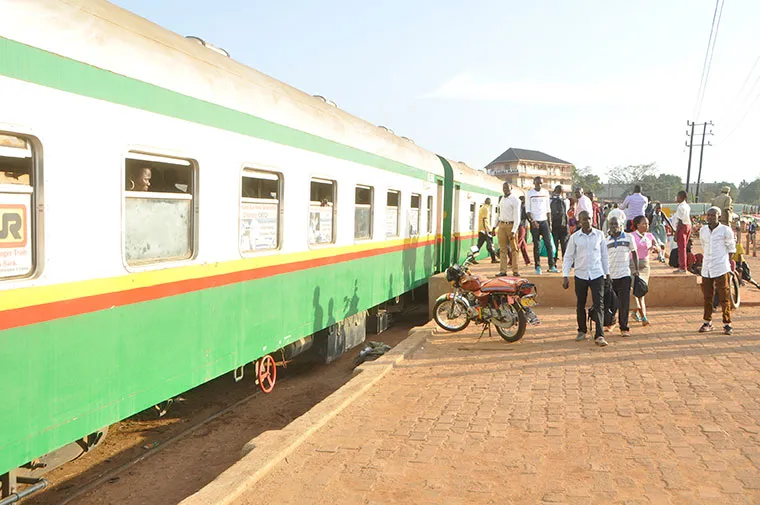
Questions over the whereabouts of hundreds of railway wagons have deepened after Parliament directed Uganda Railways Corporation managing director Benon Kajuna to make a statement to the Criminal Investigations Directorate.
At least 394 wagons valued at more than Shs220.8bn remain unaccounted for, including 281 belonging to Kenya Railways Corporation.
MPs issued the directive during a tense Physical Infrastructure Committee meeting on 23 July 2026 after saying URC had failed to provide satisfactory evidence showing where the wagons were.
Committee chairperson Mwine Mpaka, the Mbarara City South MP, demanded evidence of correspondence or joint operations between URC and Kenya Railways to locate the rolling stock.
The corporation was given an hour to produce the information, but MPs said what was presented did not establish the whereabouts of the wagons.
“The assumption is they are in Kenya, but there is also an assumption that some are sold in Uganda,” Mpaka said.
“The managing director is going to go and record a statement at police, and if he does not provide evidence within a week, the next time he reports, then we shall officially open the fire regarding the disappearance of the wagons.”
The scale of the problem was highlighted by the Auditor General in December 2025.
The audit found that, as of November 2024, URC could not physically verify 131 wagons belonging to the corporation. Officials later traced 18, leaving 113 whose whereabouts remained unclear.
More significantly, 281 wagons owned by Kenya Railways Corporation and placed under URC’s custody were also unaccounted for.
Budiope County MP Ssebbugga Kimeze said the Kenyan-owned wagons added a cross-border dimension to the controversy.
“As if that is not enough, we actually lost 281 wagons for the Kenyan railways. Property belonging to a neighbouring country goes missing here. In fact, it is stolen by our own thieves here. This is going to cause us a diplomatic problem one of these days,” he said.
MP Emmanuel Ilukol of Batoro County also raised concerns about the financial implications.
With each wagon estimated to cost about $150,000, Ilukol said authorities should treat the matter seriously and called for intervention by the State House Anti-Corruption Unit.
“It seems we are taking it lightly. Up to when must we burden the taxpayer for acts of people that are not accountable for their jobs?” he asked.
Kajuna defended the corporation’s efforts, telling MPs that tracing railway rolling stock was not a straightforward exercise and required continuous verification and engagement with Kenya Railways.
He said committees involving officials from the two railway corporations had been formed and meetings held as part of efforts to reconcile their records.
MPs, however, questioned how hundreds of numbered railway assets could remain without confirmed locations.
Kole North MP Samuel Opio said the corporation should be able to establish the movement of individual wagons through their identification records.
“We don’t know whether they were stolen, we don’t know whether they have been sold, we don’t know whether they are in Kenya. Wagons cannot just be stated to have disappeared. They are supposed to have wagon numbers, identification numbers, traceability of their locations,” Opio said.
The investigation is expected to focus on URC’s asset registers, railway yards and sidings as well as records of wagons exchanged between Uganda and Kenya.
Uganda’s railway network provides an important freight connection to Kenya and the Port of Mombasa, through which a significant share of the country’s international cargo is transported.