

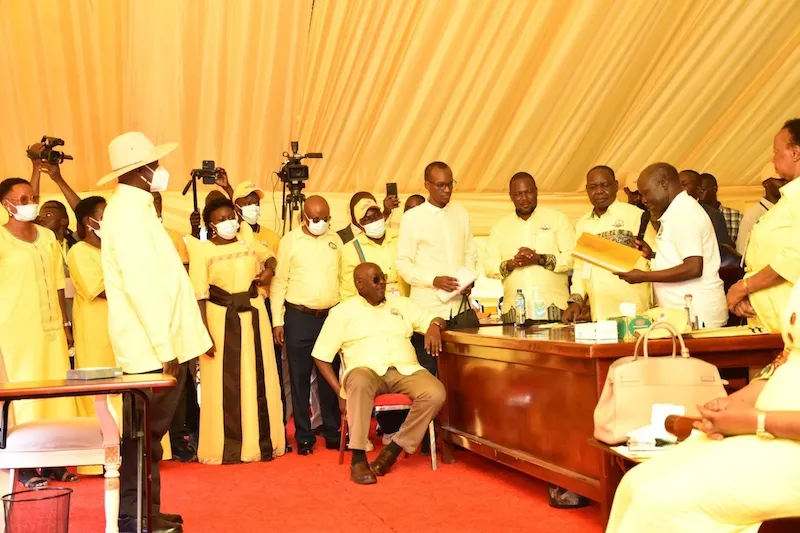
President Yoweri Kaguta Museveni has laid out six strategic pillars to steer Uganda’s future development as he prepares to seek another term in office, following his unopposed nomination as the National Resistance Movement (NRM) presidential flag bearer and party chairperson for the 2026 general elections.
Speaking shortly after being officially nominated by NRM Electoral Commission chairperson Dr. Tanga Odoi at the party headquarters in Kampala, Museveni expressed gratitude to his legal team and supporters who helped meet the nomination requirements, including collecting signatures from across the country.
He outlined the guiding principles for national transformation in his upcoming term, which include maintaining peace and security, accelerating development, promoting wealth and job creation, ensuring access to essential services such as healthcare and education, and fostering spirituality. These pillars, he argued, are crucial for building a resilient and prosperous Uganda.
Museveni warned against any threats to national stability, stressing that peace is a non-negotiable foundation for sustainable development. He emphasized the importance of personal initiative in wealth creation, noting that while the government provides infrastructure and services, individuals must take responsibility for improving their own economic conditions—especially in urban poor areas.
He criticized the dependency mindset among some youth, urging them to explore opportunities beyond government employment and encouraging more support for the private sector, which he said faces challenges that need urgent redress to stimulate job creation and investment.
Reflecting on Uganda’s past, Museveni recalled the institutional collapse and lawlessness of the post-independence era, citing incidents such as the 1972 killing of Chief Justice Benedicto Kiwanuka. He argued that since the NRM’s rise to power in 1986, the government has focused on restoring stability, building institutions, and modernizing the economy.
He cited progress in infrastructure, industrialization, agriculture, and value addition, noting that Uganda’s economy has expanded 16 times since 1986 and is now out of the Least Developed Countries (LDC) category. Still, he admitted that challenges like corruption remain a barrier to achieving even greater milestones, such as attaining middle-income status.
Museveni highlighted growing global investor interest, particularly in gold processing and manufacturing, and expressed confidence in Uganda’s future if governance is improved. He called on Ugandans to make informed political choices based on history and practical realities rather than emotions.
With the nomination secured, Museveni now looks ahead to the 2026 general elections, where he will face candidates from other political parties. He concluded by seeking divine guidance and reaffirming his commitment to work with NRM structures to ensure Uganda’s continued transformation and global relevance.